Traditional advertising measurement often stops at short-term sales impact, leaving the long lasting value of brand building unaccounted for.
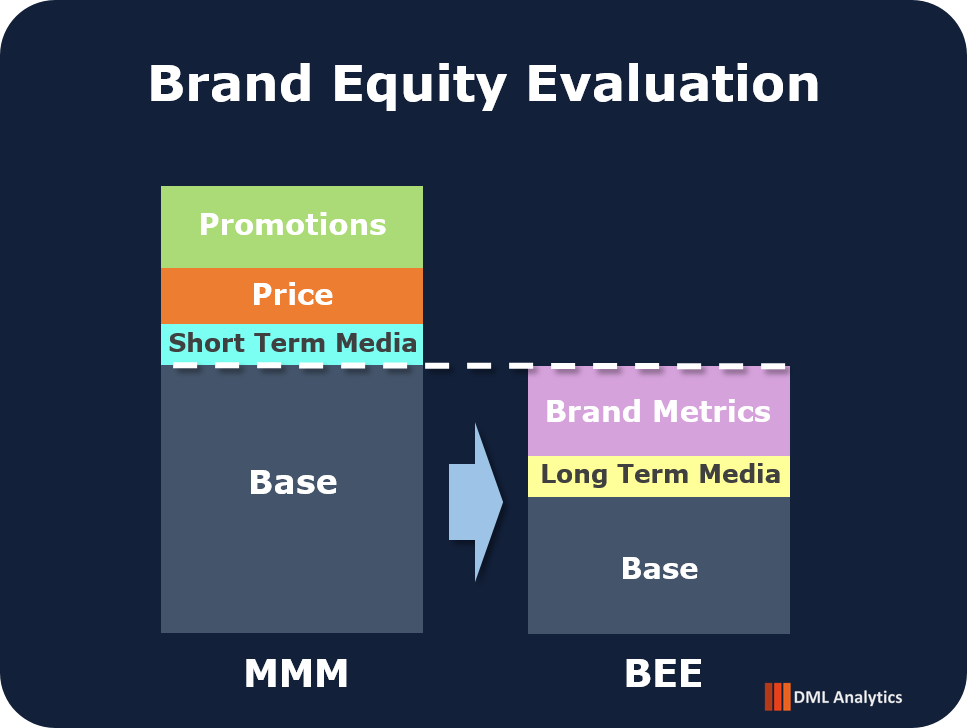
Brand Equity Evaluation (BEE) bridges this gap by extending your existing MMM to quantify the true intrinsic strength and long-term equity of your brand.
Book a 30-minute call
What you’ll gain
Brand Equity Evaluation replaces guesswork with solid financial proof, giving you the evidence needed to defend, optimise, and scale your long-term brand investments.
The value hidden in your baseline
Every MMM shows a baseline that looks like background demand.
But that baseline evolves over time, driven by measurable components such as your long-term advertising, consumer perception, and true base demand.
When is brand equity evaluation useful
Brand Equity Evaluation builds directly on stable MMM, making it the natural next step for businesses ready to measure what their brand strength is delivering beyond the short term.
This is worth pursuing when you need to:
Deconstruct your baseline - Understand exactly which media and market factors are driving your organic and long-term baseline sales.
Justify brand investments - Prove the long-term revenue impact of brand-building to stakeholders focused on short-term metrics.
Balance your media strategy - Weight short-term activations against long-term brand building while planning media.
How I work
Baseline Audit & Feasibility
Assess fit of existing MMM
Audit available brand equity & consumer health metrics.
Agree look-back window - typically 18 months min.
Model Build
Isolate contribution to baseline of brand metrics & historical advertising
Quantify drivers’ influence on long-term sales performance
Select optimal model for business objectives
Validation & Sign-Off
Validate brand model insights against MMM model
Present and agree findings with key business stakeholders
Sign off the finalised model
Solution are tailored to business context, data maturity, and specific behaviour you need to predict.
FAQ
MMM measures the short-term sales contribution of media and other commercial drivers.
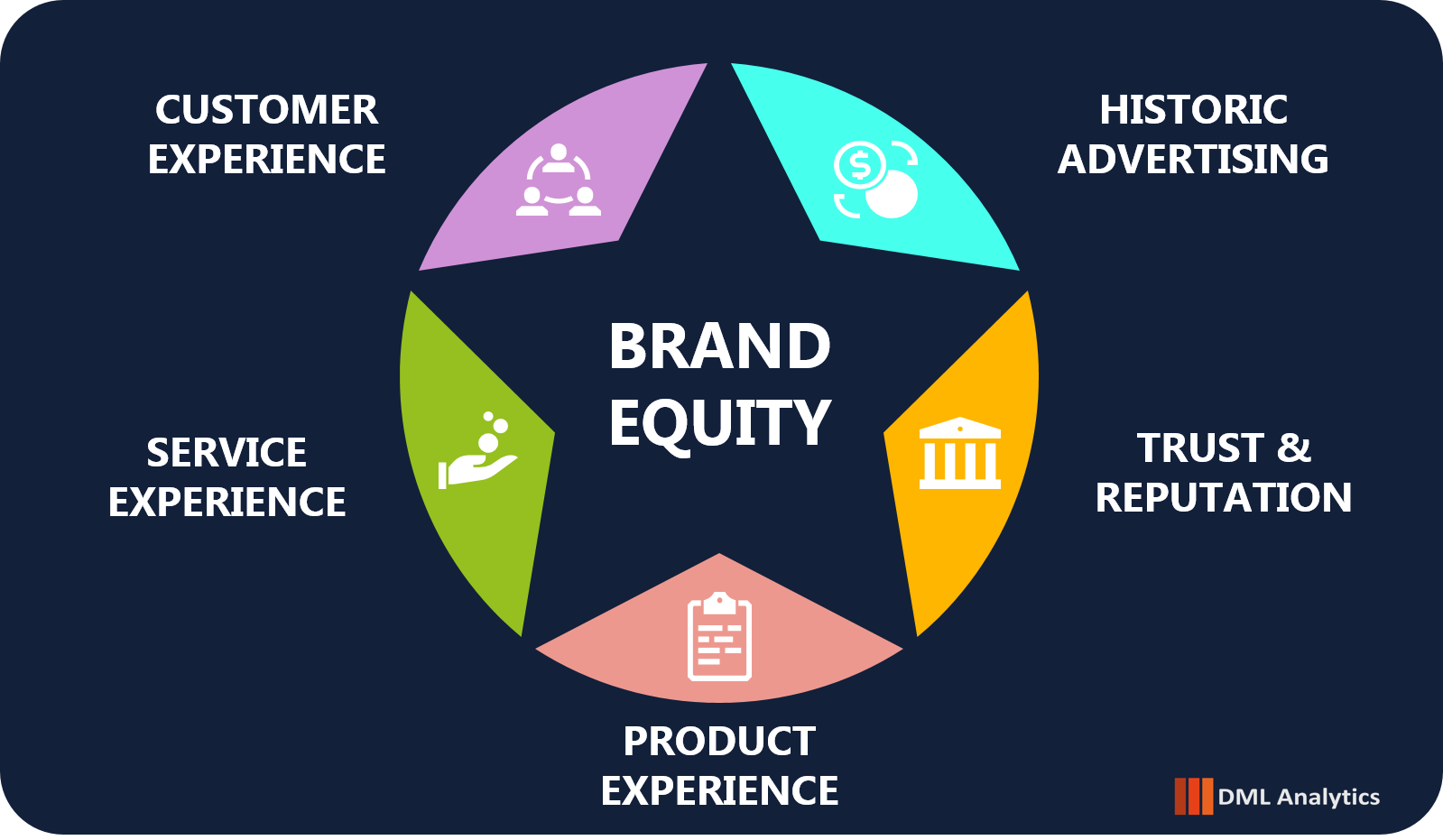
Brand Equity Evaluation focuses on long term drivers such as brand perception, consumer experience, and historical advertising and how they are contributing to long-term sales performance.
Yes. Brand Equity Evaluation is built on top of a stable and well-specified MMM. If your MMM is recent or still being refined, that is the right starting point before considering this service.
Tracked consumer perception data over the same period as the MMM, typically covering metrics such as brand reputation, likeability, consideration, NPS, and any other consistently measured brand health indicators.
The richer and more consistently collected the data, the more the model can identify and quantify the long term drivers of your sales.
Long-term brand effects can be expressed as a multiplier on short-term ROAS, giving you a more complete picture of what each channel is actually delivering.
That changes how you weight brand-building activity against performance media when planning investments.
We typically deploy structural equation modelling (SEM) to map complex, indirect consumer journeys, or vector auto-regression (VAR) to capture dynamic, time-based feedback loops between marketing and sales.
The final analytical framework is entirely dictated by your specific business questions and the depth of your historical data
There is no one-size-fits-all approach.
If your priority is understanding immediate, bi-directional momentum, a VAR model may be best. If you need to untangle deep, multi-layered brand perceptions, SEM is often preferred.
We audit your available data history and strategic goals to select the precise mathematical engine.
Assuming you already have the stable MMM in place and the historical data is clean, a dedicated Brand Equity Evaluation (BEE) project typically takes six to ten weeks, depending on data readiness and the complexity of the baseline drivers.
Typically 18 months minimum. Brand equity effects are slow-moving and shift over long periods of time (beyond 6 months+) and require sufficient history to surface reliably.
No. Segmentation is conducted using open-source frameworks whenever feasible, keeping work portable, transparent and easy to maintain & scale. This means no vendor lock-in, transparent code, and extensibility as your internal capability grows.