Budget Optimisation

Optimise Budget Before You Spend It

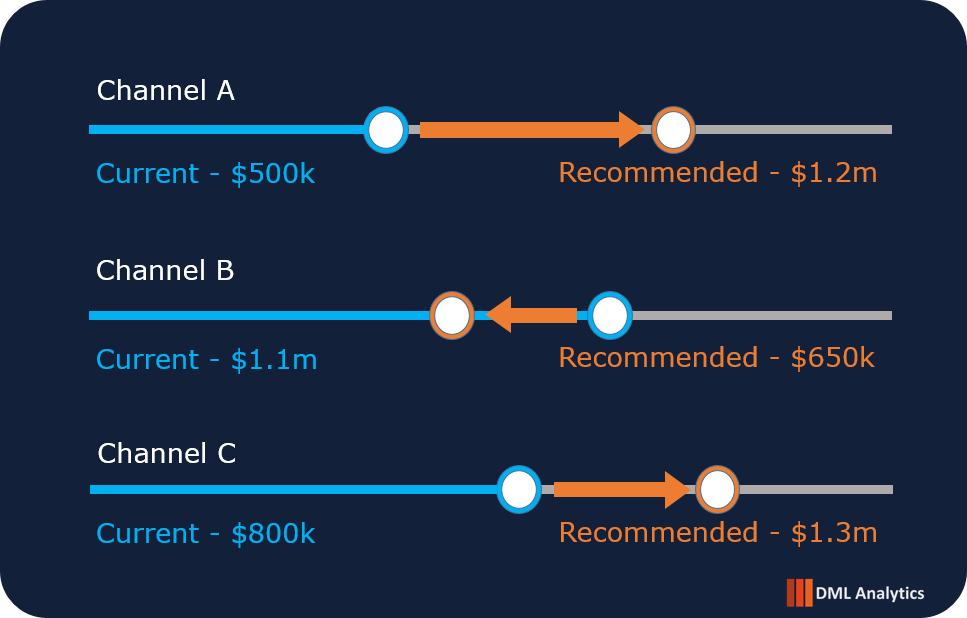
Illustrative chart showing current versus recommended budget allocation across three marketing channels.


Budget Optimisation is where marketing mix modelling output translates into practical allocation decisions based on expected impact.

Whether you’re planning next year’s budget or reallocating funds mid-quarter, I will help you see how different spending choices are likely to perform before you commit budget.


Book a 30-minute call


What you’ll gain

Budget optimisation gives you a clearer basis for allocation decisions, helping you plan faster, compare trade-offs more confidently, and make performance discussions more productive.

This keeps spend aligned to targets by showing where to invest, where to pull back, and what to protect when budgets are tight.

See how this plays out in the example scenarios below.


Fixed budget - Get more from same spend

With a fixed total budget, the allocator finds the cross-channel split that maximises expected revenue and improves overall ROAS.
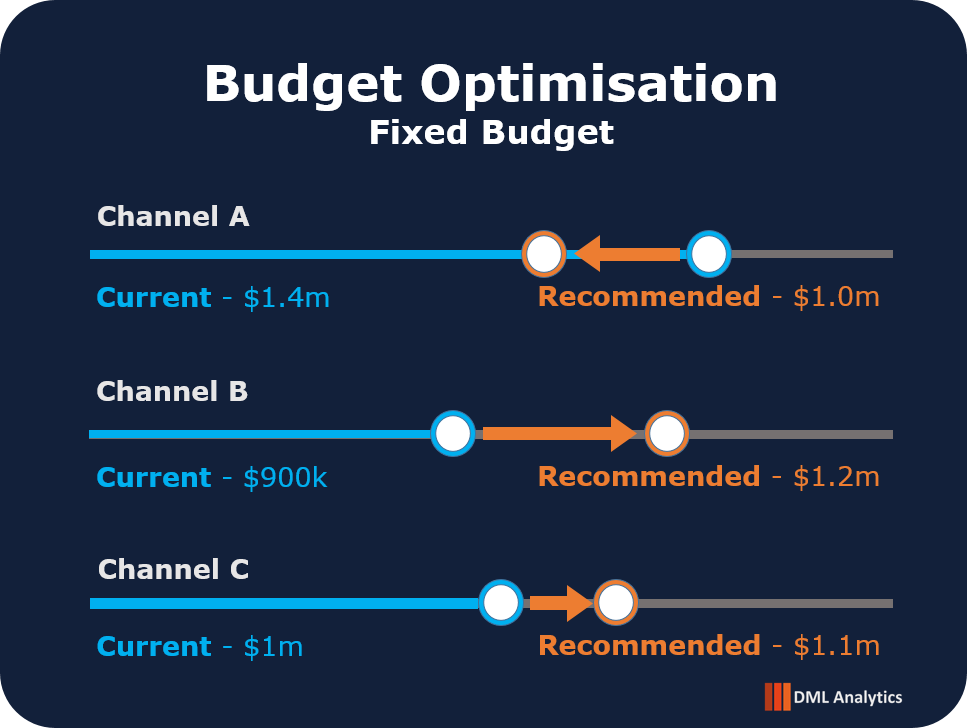
Budget allocation chart for a fixed total budget, showing current and recommended spend across channels after optimisation.

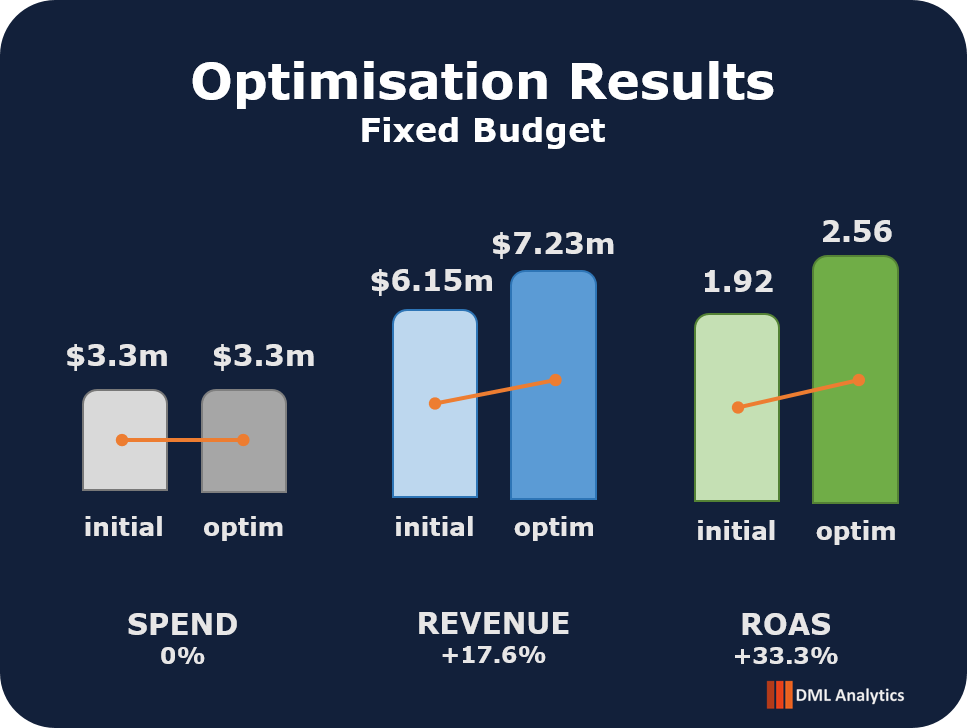
Optimisation results for a fixed budget scenario, summarising the expected improvement in revenue and overall return on ad spend after reallocation.


The initial budget is reallocated, leading to a 22.3% increase in expected revenue and a ROAS improvement of 33.3%.


Flexible budget - Find the spend to hit your target ROAS

Here, you set a target ROAS and the allocator finds both the channel mix and total budget needed to reach it.
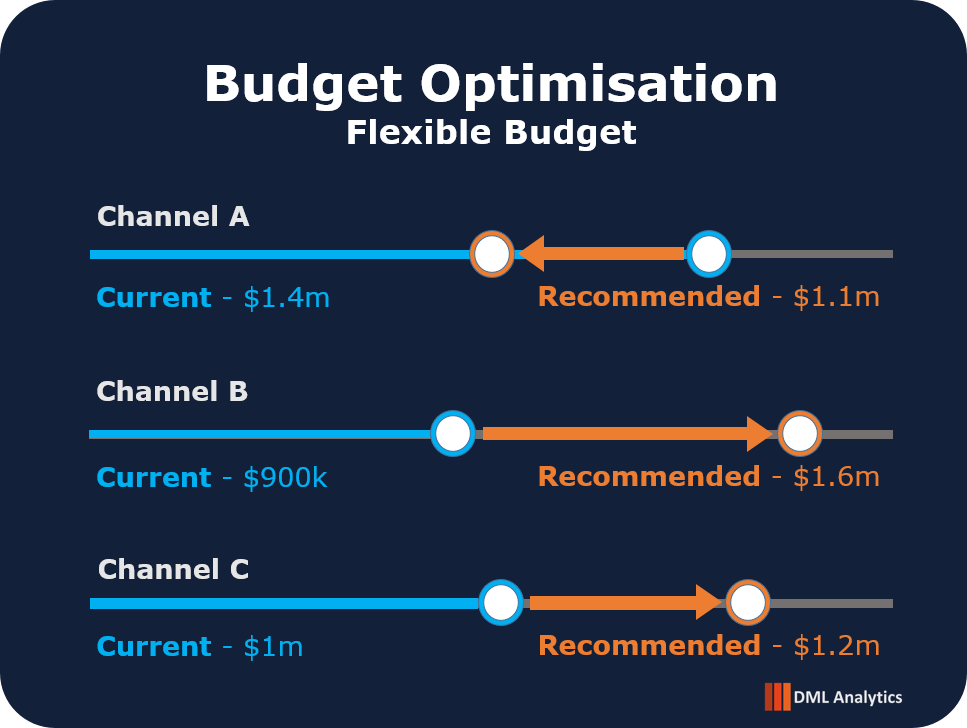
Budget allocation chart for a target ROAS scenario, showing the recommended channel mix and total spend needed to reach the target.

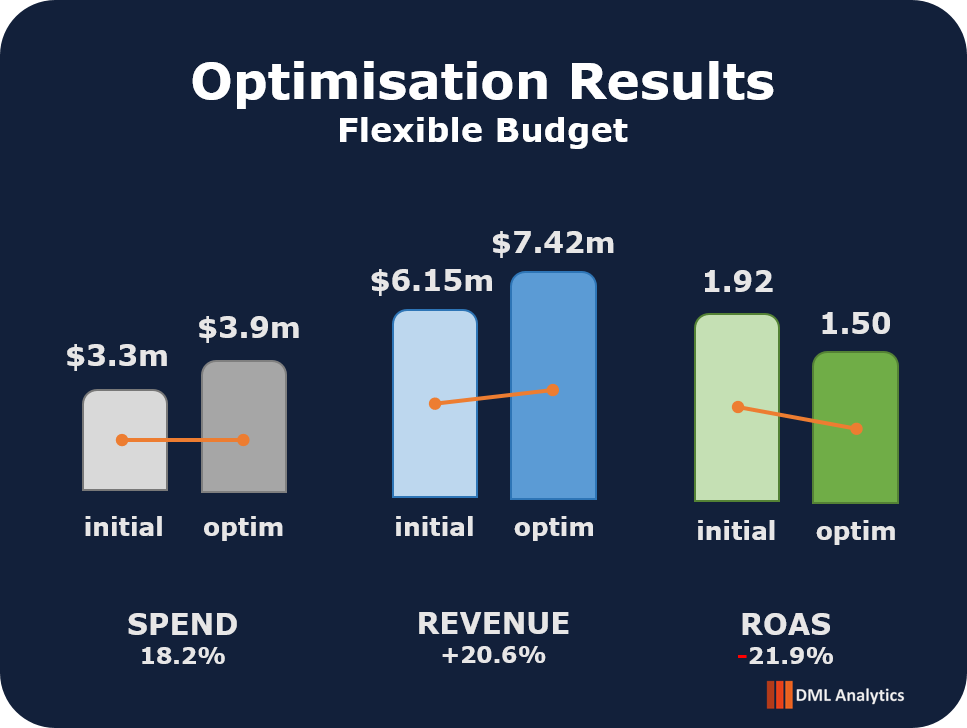
Optimisation results for a flexible budget scenario, summarising the expected response and total budget required to achieve the target return on ad spend.


The optimiser reallocates the budget, leading to a 21.8% increase in expected response alongside an 18.2% increase in overall budget.


How I work

Define Inputs & Constraints

  • Total budget caps - Upper/Lower
  • Channel-level floors/ceilings
  • Strategic fixed spend - e.g. brand campaigns, sponsorships

Run Allocation Scenarios

  • Build several plans under agreed constraints

  • Quantify marginal return & associated uncertainty by channel

Select Plans & Refine

  • Review outputs

  • Stress-test assumptions

  • Agree allocation best fitting targets & risk level

Track Actuals & Refresh

  • Track actual spend & outcomes against chosen plan

  • Refresh on agreed cadence

  • Mid-flight re-allocations - if needed

Planning sessions are typically delivered as a workshop.


FAQ

Budget Optimisation is provided as the natural extension of marketing mix modelling and not as a standalone service.
Once models & experiments (when available) are signed off by the business, we use Robyn or Meridian built-in allocators to create what-if scenarios and propose optimised allocations.

At minimum, we need a stable MMM that captures the contribution of your main paid and unpaid channels against a clear KPI such as orders or revenue. We also need your overall budget and channel-level spend so we can run realistic allocation scenarios.

We can run scenarios under strictly fixed total budgets, partially flexible envelopes, or planned budget cuts/increases in specific channels. The allocator combines MMM response curves with your budget availability to re-distribute spend inside those envelopes.

Brand-new or ultra-short campaigns often lack enough history for MMM to handle in a meaningful way. In those cases we recommend to run an incrementality test (geo-based or holdout) to estimate lift, then fold those results into the next MMM refresh. Modern MMMs such as Robyn and Meridian support calibration with experiments/priors.

A common pattern is to refresh MMM and the underlying response curves quarterly, then run the allocator in between refreshes to fine-tune budget decisions. If new information becomes available mid-quarter, such as test results or major performance shifts, scenarios can be updated earlier.

Platform optimisations usually work inside one ecosystem and can be biased by their own attribution. marketing mix modelling and incrementality tests are designed to provide a holistic, platform-agnostic and privacy-friendly view.

No. Allocation and scenario planning tools are included as standard in the open-source ecosystems we use such as Robyn and Meridian. This means no vendor lock-in, transparent code, and extensibility as your internal capability grows.

Previous projects